INDUSTRIAL & DATA CENTER COOLING NATIONWIDE
Cooling towers, steam air-cooled condensers, and hybrid adiabatic coolers — specified for your climate, process, and water constraints.
Hybrid and dry cooling systems can cut water consumption by up to 80% compared to traditional evaporative towers in the same climate zone.
Deep application knowledge across refining, power, chemical processing, hyperscale, and colocation data center environments.
Technology selection accounts for your local wet-bulb temperature, water cost and availability, and regulatory environment — anywhere in the U.S.
Use this table as a first-pass technology screening guide. The optimal choice balances thermal performance, water cost and availability, local climate, regulatory discharge limits, and total lifecycle cost.
| Criteria | Cooling Tower (Wet) | Air-Cooled Condenser | Hybrid / Adiabatic |
|---|---|---|---|
| Cooling Water Required | Yes — high makeup | None — zero water | Minimal — peak only |
| Thermal Performance |
|
|
|
| Water Consumption |
|
|
|
| Capital Cost |
|
|
|
| Plot Area | Compact | Large A-frame structure | Medium — larger than tower |
| Winter Freeze Risk | Yes — basin heat required | Low risk | Low — basin optional |
| Legionella / Drift Risk | Yes — mitigation required | None | Minimal — closed coil |
| Cold Ambient Performance | Excellent | Excellent (low back-pressure) | Excellent dry mode |
| Hot Ambient Performance | Excellent | Degrades with ambient temp | Good — wet mode activates |
| Industrial Best Fit | Process cooling >5,000 tons | Zero-discharge power gen | Water-stressed industrial |
| Data Center Best Fit | Hyperscale >50 MW IT | Edge / modular power | Hyperscale, water-stressed |
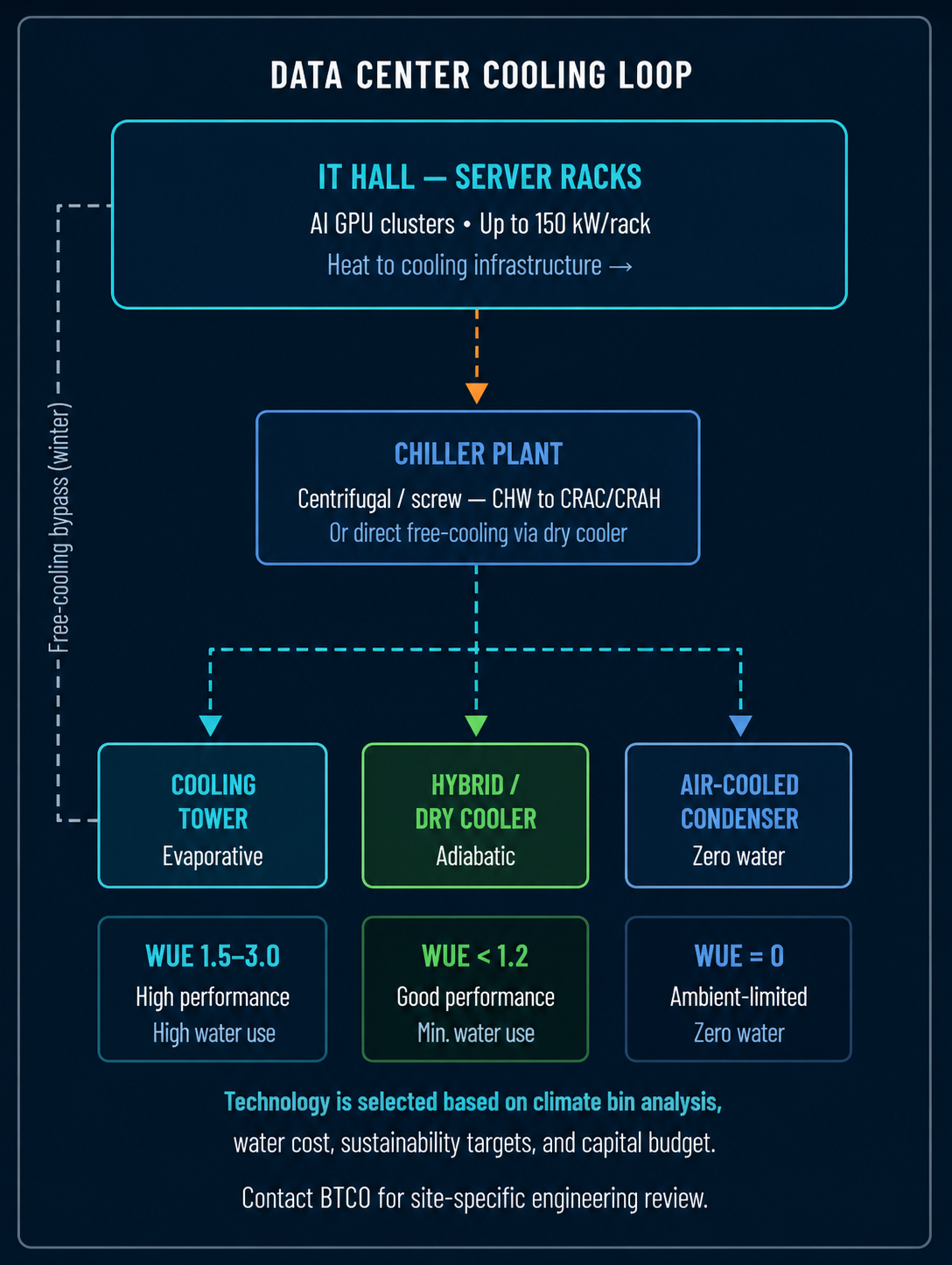
As AI training loads push rack densities above 100 kW/rack and hyperscale campuses exceed 500 MW IT load, heat rejection infrastructure becomes one of the most critical design decisions. Water availability, PUE targets, and local climate conditions all shape the optimal cooling strategy.
Hybrid and adiabatic cooling systems routinely achieve Water Usage Effectiveness below 1.2 L/kWh — helping hyperscale campuses meet aggressive sustainability targets.
Our design strategies focus on reducing overhead cooling power while maximizing IT capacity per MW of utility power infrastructure.
Next-generation GPU clusters require cooling architectures capable of handling dramatically higher thermal densities than traditional facilities.
Factory-fabricated cooling modules allow phased deployment and scalable infrastructure expansion without stranded capital investment.
Every cooling strategy is selected based on regional wet-bulb conditions, water availability, utility economics, and long-term operational efficiency.
Water discharge permits, drift mitigation, Legionella management, and ESG reporting requirements are integrated into system planning from day one.
Cooling water is increasingly expensive — and in many U.S. regions, increasingly scarce. This estimator helps evaluate annual water usage, hybrid cooling savings, and estimated operating cost reductions when transitioning from conventional evaporative systems to hybrid or dry cooling technologies.
Gallons/min evaporated per 100 cooling tons
Per 1,000 gallons total cooling water cost
Compare conventional wet cooling towers against hybrid and dry cooling technologies using estimated annual operating conditions.
Estimates shown are generalized conceptual calculations intended for preliminary comparison purposes only. Actual performance varies by climate, cycles of concentration, system design, utility pricing, and operational strategy.
Cooling tower, ACC, and hybrid systems serve virtually every heat-generating industrial sector. Engineering-backed technology selection and manufacturer representation nationwide.
Cooling system selection is not a catalog decision. Climate, water availability, process temperatures, plot constraints, and regulatory requirements all shape the optimal answer. We bring decades of industrial cooling experience to every project.
We represent multiple leading manufacturers across all three cooling technologies. Recommendations are driven by your process requirements — not by a single product line.
Our team provides detailed thermal performance calculations, psychrometric analysis, and guaranteed operating performance — not estimated brochure values.
We combine local weather data, utility costs, and water analysis to evaluate lifecycle economics and optimize long-term cooling performance.
From hyperscale data centers to refinery cooling applications, we understand operational realities, maintenance drivers, and lifecycle cost impacts.